
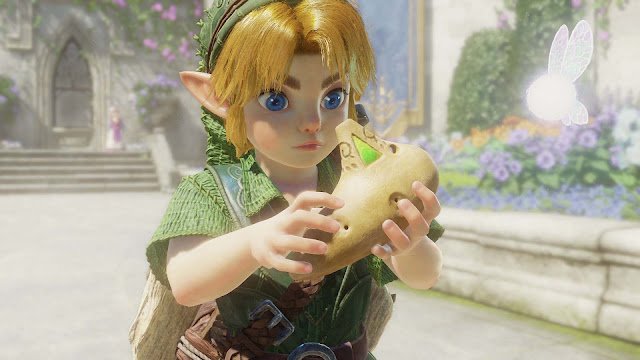
The event covered here is a special examination of why The Legend of Zelda: Ocarina of Time changed video games forever. Renewed attention around the announced Nintendo Switch 2 remake offers a reason to revisit the 1998 Nintendo 64 classic, but the central story is its influence: how one game made 3D exploration, combat, puzzles, camera control, and narrative work as one readable adventure.
The difficult transition from 2D to 3D
When Ocarina of Time arrived, designers were still learning how to make three-dimensional spaces intuitive. In 3D, the camera could hide an enemy, depth could make a jump unclear, and a larger set of controls could overwhelm players. Super Mario 64 had shown how a character could move through a 3D environment, but Ocarina of Time applied that lesson to a wider adventure in which exploration, swordplay, puzzles, and story had to function together.
The achievement was not simply putting Link in a larger world. The game created a consistent language for navigating it. Players could understand where to go, what to examine, and how to respond to danger without treating the controller like a technical manual. That clarity made the shift to 3D feel like a natural expansion of the series rather than a collection of awkward compromises.
Lock-on combat made encounters readable
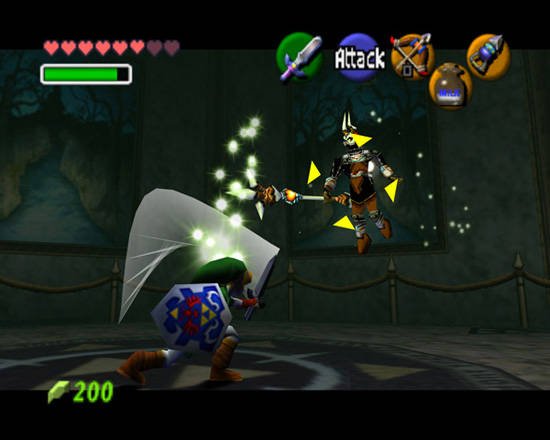
The clearest example is the Z-targeting system. Pressing the Z button lets Link focus on an enemy or point of interest while the camera follows the encounter. The player can attack, defend, and move around the opponent without constantly correcting the viewpoint by hand. That solves a basic problem of 3D combat: an enemy can be close enough to threaten the character but difficult to track in a free-moving space.
Locking onto an opponent is familiar in modern action games and role-playing games, but here it was part of a larger solution. Movement, camera behavior, and combat rules reinforced one another, allowing the player to concentrate on timing and positioning. The system helped establish expectations for third-person adventures that remain recognizable today.
Contextual controls reduced friction
The blue A button offered another lasting lesson. Its function changed with the situation: Link could use it to talk, open a door, pick up an object, climb, or perform another relevant action. Instead of assigning a separate command to every interaction, the game presented one clear option based on what Link was facing and where he was standing.
This approach simplified the controller and let the game teach through action. Players learned what the button could do by approaching a door, object, or character and trying it. The environment became part of the tutorial, introducing systems without stopping the adventure for long explanations.
The camera became a design tool
A good camera is easy to overlook because it quietly supports the player’s decisions. In Ocarina of Time, camera positioning helped frame combat, emphasize the size of a room or boss, and guide attention toward the next meaningful direction. Changes in perspective could turn an entrance, discovery, or confrontation into a clear dramatic moment.
That gave the camera a role beyond following the hero. It became a tool for communicating scale, focus, and progress. When a modern adventure presents a large boss clearly or guides the player toward an objective through framing, it uses a vocabulary this game helped make familiar.
Dungeons taught through structure
The dungeons showed how those systems could become lessons rather than isolated features. A new item or ability was introduced, its purpose became clear through experimentation, and later rooms demanded more confident use of it. The dungeon itself became a tutorial that never felt separate from the challenge.
Progress also depended on reading the environment rather than relying on brute force. A suspicious wall, distant platform, web, or apparently unimportant switch could matter more than the enemy in front of Link. The relationship between a new tool and the dungeon built a durable model for action-adventure design.
Hyrule connected place, time, and story
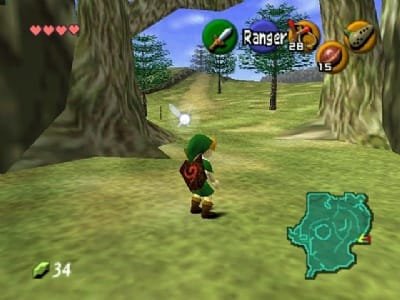
Hyrule was not merely a corridor between dungeons. The player encountered distinct regions, characters whose circumstances could change, secrets that rewarded exploration, and a sharp contrast between Link’s childhood and adulthood. The kingdom’s transformation after the time jump communicated narrative progress through the spaces themselves, not only through dialogue.
The presentation supported that integration. Scenes were created in real time, helping preserve continuity between interactive play and story moments. The player did not simply watch a plot between levels; the world changed around the character and made exploration part of understanding the story.
Music became something the player performed
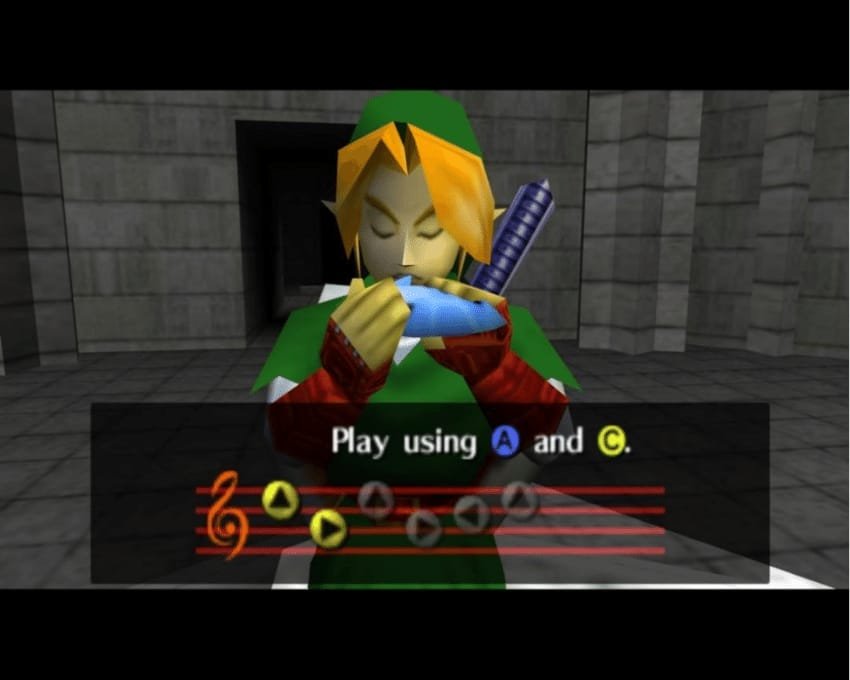
Koji Kondo’s music extended the same idea. The ocarina was not merely an atmospheric prop. Players had to remember note sequences and play them at the right moment to solve problems, reach places, and advance. Music became a mechanic that asked for participation instead of passive listening, while its melodies gave different parts of Hyrule a distinct identity.
Why the influence still matters
Ocarina of Time did not invent every idea associated with 3D games. Its breakthrough was combining many solutions into one coherent structure: lock-on combat, contextual actions, camera design, environmental puzzles, staged learning, world-based storytelling, and interactive music supported one another.
That influence is reflected in its continued historical recognition. It was selected for the World Video Game Hall of Fame in 2022, where its sprawling 3D world, fluid combat, complex puzzles, and time-shifting story were highlighted as qualities that continue to influence developers. Nearly three decades after its Nintendo 64 release, the reason to study Ocarina of Time is larger than nostalgia. It showed how a 3D adventure could be understandable, expressive, and rewarding at the same time. Many games still speak that language.