
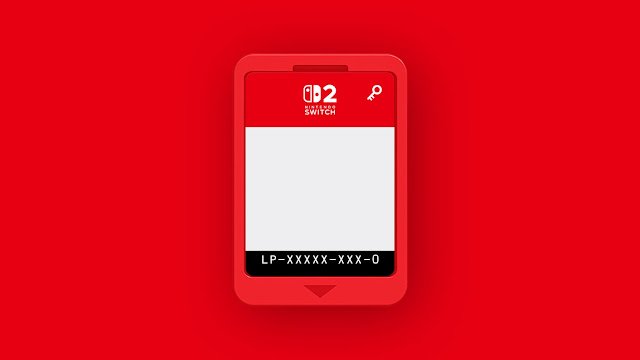
That question is precisely what the Game‑Key Card was created to answer: a physical format for Nintendo Switch 2 that keeps the look and part of the experience of a traditional physical release, but works in a different way.
As games keep growing in size, Game‑Key Cards are likely to appear more frequently on store shelves.
What is a Game‑Key Card?
A Game‑Key Card is a physical card that does not store the full game data. It functions as a key that authorizes a Nintendo Switch 2 to download the software from the internet.
The first time the card is inserted into a console, the Switch 2 must be connected to the internet and have enough free space in internal storage or on a microSD Express card. After the download completes, the game can be launched normally without an internet connection.

There is one important condition: the Game‑Key Card must remain inserted in the console for the title to run, just like a traditional cartridge. The physical card is still required to play and can be used on another Nintendo Switch 2, provided the download process is repeated on that console.
Older players might remember a similar model with PC CDs: even when a serial code was provided in the box, some titles still required the physical disc to be present in the drive to run.
How does it differ from a regular cartridge?
The fundamental difference is where the game data is stored. A traditional cartridge contains the full files required to run the game, while a Game‑Key Card requires the game software to be downloaded and installed on the console.
In practical terms, three elements are involved: the retail box, the physical card itself, and the installed data on the console. That explains why a Game‑Key Card can still be considered physical media even though it does not provide the same out‑of‑the‑box experience as a conventional cartridge.
Why are publishers using Game‑Key Cards?
The main reasons are cost, storage capacity, and technical characteristics of modern games. As titles become larger, it’s harder to fit them into a limited physical medium.
Memory cards capable of storing full games are more expensive to produce than a medium that contains only a key. For a publisher releasing an adventure that can be tens of gigabytes, that cost difference multiplies across thousands or millions of units.

Regarding storage, the Nintendo Switch 2 includes 256 GB of internal space, while modern games can take a large slice of that capacity. For example, Cyberpunk 2077: Ultimate Edition requires 60.6 GB of storage in the Brazilian digital version.
On the technical side, read speed is a concern. Even high‑quality, high‑speed memory cards can face playback issues with demanding titles. Star Wars Outlaws, for example, uses a Game‑Key Card on Switch 2; a Ubisoft developer said the performance needs of the Snowdrop engine were one factor in the decision for that physical distribution.
There isn’t a single reason publishers choose the format. From a commercial perspective, the solution that reduces costs is often the one that wins.
Advantages
For consumers, the main benefit is that a Game‑Key Card preserves several characteristics traditionally associated with physical releases:
- Resale: because the card is not tied to a Nintendo account, you can sell or buy a used copy;
- Lending: the owner can lend the card to someone else, who can download the game on their own Switch 2;
- Collectability: there’s a box—sometimes with inserts or extras—a tangible object to keep in a collection, something a purely digital purchase doesn’t offer;
- Offline play: an internet connection is only required for the initial download; once installed, the game can be launched without being online.
Disadvantages
Many players feel the format has more drawbacks than benefits. The main downsides are:
- Internet required to run: you can’t play immediately after opening the box if there’s no Wi‑Fi nearby;
- Uses internal storage: Game‑Key Card titles occupy the Switch 2’s internal space. In many cases there’s no difference in download size between buying the digital version and the card version;
- Preservation risk: a traditional cartridge retains the data needed to play for decades (provided the hardware and media still function). A Game‑Key Card depends on online infrastructure to download the game — if you delete the software or try to reinstall after services are shut down, the card becomes just a paperweight.
That is why Game‑Key Cards spark heated debate among collectors, although some defend the format as a way to help the industry. It offers a physical way to buy, resell and store a game, but it doesn’t provide the same independence as a cartridge. It can feel more like a temporary loan model than a final purchase.
So which is better: physical or digital?
If convenience is the priority, digital delivers nearly the same experience without needing a physical card. If your goal is collecting, reselling or lending, a Game‑Key Card has an advantage over a simple digital license.
But if you want a medium that works independently of online services and offers greater long‑term preservation, traditional cartridges remain the preferred option — even though they’re becoming rarer.
It’s unlikely every Nintendo Switch 2 title will adopt this model. Nintendo itself makes a distinction between two kinds of cards — Game‑Key Cards and traditional cartridges — and some companies will continue to use conventional media.
From publishers’ point of view, the trend makes sense: games are getting larger, physical storage costs matter, and consumers still want boxed editions. Nintendo’s Game‑Key Card is a compromise that attempts to reconcile those realities.
For players, the key question before buying is simple: what’s inside the box? If it’s a traditional cartridge, the game is on the media. If it’s a Game‑Key Card, the card is only the key.
What do you think? Do you prefer physical media or are you already committed to digital versions? Share your thoughts in the comments.